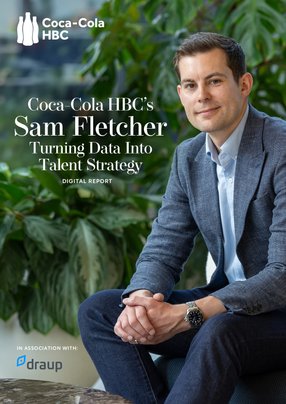
Years before joining Coca-Cola HBC, Sam Fletcher worked at a search firm where he watched his colleagues help the beverage giant roadmap its early vision for talent intelligence. He found the concept incredibly fascinating, and, six years later, is now the company’s Head of Research and Talent Intelligence, bringing that very roadmap to life.
In this exclusive interview, Sam breaks down why talent intelligence has become a mission-critical function, how data elevates HR from reactive to advisory, and how leaders can leverage external market insights to gain a proactive competitive edge.
How do you personally define talent intelligence, and why is it a mission-critical function?
For me, talent intelligence is the ability to bring talent-related data – mainly external labour market data – to support business decisions. That makes it sound much simpler than it really is, but it’s just the starting point. Realistically, talent intelligence is gathering, analysing and translating external labour market data, overlaying macroeconomic data and combining it with internal talent-related and wider business data and context. It then provides recommendations to the business.
For example, a simple talent intelligence project might be analysing how many software engineers are within a commutable distance of an office to confirm how large a software development team should be built there.
A more complex project might evaluate comprehensive market variables like talent pool diversity, localised real estate and tax costs, competitor attrition rates and local university pipelines. I’d argue that talent intelligence becomes mission-critical the moment accessing and understanding talent becomes vital to the business. I think that’s the reality for most, if not all, businesses today.
When you look globally, companies are operating in increasingly constrained, competitive and complex talent markets. As a discipline, talent intelligence helps businesses understand how skills and work are changing with technology advancements and shifting economies, which is what gives many companies the competitive edge.
I could talk about what talent intelligence is and can do to add value to a business for hours, but the clue for me is in the name. If you’re doing it right, it should go beyond analytics and insights and should be proactive and support business decisions.
What was the strategic vision behind formalising talent intelligence as a dedicated capability for Coca-Cola HBC?
As a business, Coca-Cola HBC has very well-defined bespoke capabilities. One of those capabilities is data, insights and analytics. Talent underpins all our bespoke capabilities, so having an industry-leading talent intelligence team bringing data, insights and analytics to those talent and business activities and decisions aligns well.
The vision for the capability came from Coca-Cola HBC’s Head of Talent, Kiriaki Kritidi, and Group Head of Executive Search, Juan Calvo. The executive search team had been running talent intelligence projects for several years, compiling industry news, company profiles and insights into comprehensive reports to support hiring decisions. Much of the work was being supported by external partners, and the team’s capacity was limited due to the primary focus on hiring and proactively building talent pipelines, so the decision was made to build talent intelligence as a capability with dedicated headcount and processes.
The discussions I’ve been having with the leadership team about where talent intelligence adds value and supports the business are exciting, particularly with the scale that comes with working for a business like Coca-Cola HBC. The natural short-term objectives for talent intelligence are focused on supporting executive recruiting and broader talent acquisition efforts, including areas like strategic workforce planning. The longer-term approach is to support the wider talent function and connect it more closely to the strategy of the business.
Why are more companies setting up specific talent intelligence teams and capabilities – what impact is this having?
Over the last few years, three things have led to more companies setting up a talent intelligence capability. The first element is that HR as a function has become incredibly data-focused, and there is a stronger demand by corporate HR and talent teams for external data. The second is that labour market data and analysis are much more readily available and in a format that is accessible, especially with advancements in AI. The third is simply awareness of talent intelligence and the realisation of the value that it brings to a business from HR and talent leaders.
The real impact I see is that, with more companies setting up talent intelligence teams or capabilities, it elevates everything talent teams are doing and allows them to become more connected with the business groups they support. Recruiting teams with market data become more advisory rather than reactive and are much more effective as a result. People Analytics teams that collaborate with Talent Intelligence teams bring external data to compare or benchmark what they are seeing from internal data, and can present a complete picture and be much more predictive. One example of that is attrition data. People Analytics teams who say “our voluntary attrition increased by 2%,” sound like a problem; the same team with market data saying “our attrition increased by 2%, but our competitors increased by 4%,” is a very different story.
You've built talent intelligence teams previously. What did you learn when moving the capability from talent acquisition into strategic workforce planning?
The biggest lesson for me was understanding how connected the function is with the rest of the business, or indeed, how connected the main leader is, rather than specifically where talent intelligence sits. A talent intelligence team in a Talent Acquisition group that isn’t well-connected to the business means that talent intelligence will only ever be effective as a recruiting enabler. Equally, a talent intelligence team based in strategic workforce planning may be limited in terms of short-term impact and ROI measures if the team isn’t connected with shorter-term business priorities.
Equally, the wider business context is key when deciding where a talent intelligence capability should sit. At my previous company, the function evolved from supporting hiring into informing strategic workforce planning, supporting org design and leading on location strategy. I made an intentional choice to try to work more “upstream” with business and HR leaders, as it was much more effective to inform decisions about hiring plans when they were being made. It was less effective in bringing the data to situations where hiring wasn’t going as planned, and recruiters either needed a new strategy or wanted to change the location or scope of the roles being hired.
How does your current work serve as the foundation for the broader talent intelligence insights you provide to the business?
I’ll share an example that connects to a lot of business decisions, as I think it is a great example of where talent intelligence teams can add value relatively quickly. Companies usually establish lists of peer companies to help with compensation benchmarking. Typically, this is managed by the compensation team. They then partner with a provider to advise them on which companies to include based on market presence, employee and revenue size, competitive industry overlap and participation in their compensation surveys.
The approach we have taken is to partner with the compensation team to work across the talent function and business to gather inputs on which companies we compete with for talent, which we hire from across industries and which our employees go on to join. Once we had that feedback, we analysed job postings based on the geographies, roles and skills we hire for, to identify which companies have similar hiring to us to make sure we didn’t miss any companies that we had not been previously aware of, regardless of industries.
Setting peer company lists by each business unit and market has allowed us to align recruiting, compensation and other talent and business teams on who our peers are.
Once that has been confirmed, we are then able to better understand the talent markets you operate in and identify trends, which allows you to be proactive.
As part of the business planning process, you can then bring even more insights into discussions. For example, you can identify which capabilities or skills are key to achieving the growth goals of each business unit or market to then follow signals that show if those capabilities or skills are increasing or decreasing in demand, and which industries or companies are competing for those capabilities and skills. That level of analysis can be used to identify what talent planning should look like.
For HR leaders without a data background, what is the best way to start leveraging these capabilities to drive their own agendas?
First, I’d find a “go-to” data person in your team who can support you. You don’t necessarily need an experienced data analyst, but someone with good Excel capabilities and who understands data concepts.
You then need to identify challenges where data can provide recommendations, or where data can highlight trends to inform decisions. I’d always recommend starting small with a pilot project that is low effort, low investment and low risk. One example might be to analyse the companies you hire from and lose talent to. That can be as simple as pulling the data from your recruiting or HR system to understand which companies you are hiring from, and then analysing public profiles, such as LinkedIn, to see which companies your previous employees went on to join.
Once you have gone through a few pilot projects, you can start being more adventurous about bringing data to larger challenges or business decisions and assessing other data sources, including from labour market data providers, to build the capability further.
What is your key takeaway message for other HR and People leaders?
The one thing I’d say is to sit down with your leadership team, including your talent acquisition leader, and have a conversation about where labour market data and talent intelligence are on your roadmap, where they can support your key priorities and how you can connect data with other functions to unlock value.
Company portals

Executives

Sam Fletcher
Head of Research & Talent Intelligence