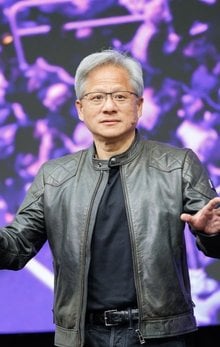
NVIDIA CEO Jensen Huang: AI Creates Jobs, Not Unemployment

Technology leaders are split on how AI will reshape white‑collar work – and the divergence has direct implications for HR strategy.
Some CEOs foresee rapid displacement. Anthropic CEO Dario Amodei has suggested that AI could eliminate entry‑level white‑collar roles within five years, arguing the technology will be “better than humans at almost all intellectual tasks,” as he told CNN.
Others anticipate augmentation over replacement.
NVIDIA CEO Jensen Huang contends AI agents will function more like hyper‑attentive managers than substitutes for employees: “Your [AI] agents are harassing you, micromanaging you and you’re busier than ever,” he said during a panel at the Stanford Graduate School of Business.
“We’re doing things faster; we’re doing it at a larger scale; we’re thinking about doing things that we never imagined.”
For CHROs, these views frame two parallel realities to plan for: potential erosion of traditional early‑career pathways and the intensification of work under AI‑enabled oversight.
The agenda now is to redesign job architecture and entry routes, accelerate skills development and internal mobility and establish governance for AI agents that protects employee experience while converting productivity gains into sustainable performance.
Clear decision rights, updated performance standards and manager capability will be pivotal as organisations balance speed with trust in an AI‑first operating model.
The incoming AI revolution
Jensen Huang has pushed back against the idea that AI will hollow out human‑centric work. “My belief is we’re gonna create more jobs in the end,” he said. “There’ll be more people working at the end of this industrial revolution than at the beginning of it.”
While NVIDIA and other tech leaders are realising gains from AI integration, employees across sectors are bearing the brunt of rapid transition. Some companies, including Meta, are weighing headcount reductions to offset AI costs and automate simpler tasks.
According to Nikkei Asia, nearly half of recent tech layoffs have been attributed to AI, with almost 80,000 jobs cut in the first quarter of 2026 – evidence of a near‑term dislocation even as long‑term productivity ambitions rise.
The priority is to balance automation with employability by redesigning job architecture, accelerating reskilling and internal mobility and creating clear pathways for redeployment from sunset roles to growth roles.
Equally important is governance for AI deployment – defining decision rights, safeguards and performance standards – alongside transparent communication and manager readiness to sustain trust through change. The organisations that convert AI from disruption into durable advantage will treat talent strategy as the primary lever for value creation, not a downstream consequence of technology choices.

In contrast to prevailing concerns, Jensen Huang argues that while chatbots and AI agents are rapidly expanding their capabilities – from writing code to managing schedules and organising data – the technology will ultimately enable more human work, not less.
“The fact that we now have AI assistants [to] help us, we could explore more space, do better work, do things at a greater scale, do things more cost‑effectively, do things better,” he said.
He concedes some roles will become redundant as the AI era unfolds, but remains optimistic about the net impact: “My belief is we’re gonna create more jobs in the end. There’ll be more people working at the end of this industrial revolution than at the beginning of it.”
AI Anxiety among workers
That optimism sits alongside growing unease on the ground. The instability of the US labour market has heightened collective anxiety, with ADP Research reporting in 2025 that only one in five workers felt their jobs were safe from elimination. Some employees are resisting AI adoption outright in hopes of influencing how the technology is deployed across industries.
Huang has sought to reassure those uneasy about integration, framing AI as the latest in a series of transformational shifts that ultimately expand opportunity.
Citing the Industrial Revolution, he urged leaders and workers to separate roles from tasks: “[What] I want to make sure we all do, is to recognise that people are really worried about their jobs,” he told the Lex Fridman Podcast in March.
“I just want to remind them that the purpose of your job and the tasks and tools that you use to do your job, are related, not the same.”
Company portals

Executives
Jensen Huang
Founder and CEO