How are People Leaders Changing Their Approach to Talent?

Insights from Bain & Company’s Chief People Officer Forum find that talent leaders are rethinking their approach to talent acquisition and retention as the enterprise working environment evolves.
The organisation surveyed Chief People Officers (CPOs) and talent officers globally as part of the forum, and found that companies are learning to navigate a more turbulent environment, with capital becoming more constrained, talent pools shrinking and AI changing widespread approaches to work.
Of those surveyed, 70% shared concerns about slowing labour market momentum, and the potential spillover effects on economies in the EMEA and Asia-Pacific regions.
Many leading CPOs revealed that they were already rethinking how they hire globally because of this, with geopolitical boundaries and labour shortages playing the biggest role in the development of people strategies.

Managing people strategy as ways of working evolve
To address these challenges Bain encourages HR leaders to implement new technologies in their people strategy, citing AI as a “necessity to sustain productivity and economic growth”.
It found that HR leaders are using the technology to draw from new talent pools, improve efficiency and work as a “cost lever” to meet needs arising from skills shortages.
Similar findings were seen in a September 2025 IBM study, which found that 62% of CHROs are prioritising automation in recruitment, while 61% are using it in employee self-service with digital assistants and 52% in talent acquisition.
Discussing AI in a keynote speech at an HR Tech conference in September 2025 Nickle LaMoureax, CHRO of IBM, said: “AI is not magic. It’s amazing, impressive technology that can totally transform your business.
“But it takes hard work, behaviour change, culture change, business process change and sometimes leadership change.”
Bain expresses a similar sentiment, recommending that HR leaders look closely at their AI integrations to ensure they maintain the same standard of work as a human, or better.
Some areas, the report advises, will still need human empathy, trust and presence.
How are companies approaching AI integration?
Toyota has taken the use of human-AI collaboration as a central facet of its strategy, with the manufacturer combining automation with human expertise in a principle it calls jidoka.
Discussing this in a press release, Kazuaki Shingo, Chief Production Officer of Toyota, says: “I want to change the future of car-making through Toyota’s skill.
“To achieve this, we need to evolve the monozukuri [production] strengths that only Toyota possesses through the fusion of human skills, technology and digital techniques.”
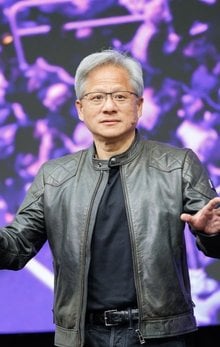
Other companies are investing in AI technologies on a mass scale – such as NVIDIA, where CEO Jensen Huang recently told managers: “My understanding is that NVIDIA has some managers who are telling their people to use less AI”, as reported by Business Insider.
He continued “I want every task that is possible to be automated with AI to be automated with AI. I promise you, you will have work to do.”
Bain’s insights suggest that the rapid acceleration of AI is not a temporary disruption, but a reshaping of the way organisations approach work.
The survey finds that CPOs are playing a key role in leading that transition, which it argues will define the competitive advantage of businesses in years to come.
Company portals



Executives
Jensen Huang
Founder and CEO

Kazuaki Shingo

Nickle LaMoreaux
Chief Human Resources Officer