Goldman Sachs CEO: AI will not Impact Company Headcounts

David Solomon, Chairman and CEO of Goldman Sachs, has shared that he believes jobs are not at wide scale risk because of AI.
Speaking on the Goldman Sachs Exchanges podcast, David said: “Technology has been disrupting jobs, changing the way people work, destroying jobs and forcing us as a vibrant economy to create new jobs for decades.”
The effects of AI on hiring and retention
David has expressed a similar sentiment before, telling Bloomberg in October 2025 that he believes Goldman Sachs will hire more people through further implementation of AI, rather than fewer.
“I think we can continue to serve a wider slice of clients with these tools, and these capabilities being integrated into the firm”, he said, adding that if the company can continue growing, they can “invest in other areas for growth”, leading to an increase in headcount.
The company did announce that it would be restricting headcount in the short term as part of its OneGS 3.0 programme – an AI-led initiative to grow the business and deliver more synergy to brand services.
Goldman Sachs developed OneGS 3.0 to enrich the employee experience, strengthen resilience and drive productivity through automation.
The firm reported in an internal memo shared by Business Insider that the decision to reduce roles was made to prioritise “gaining more agility and creating the right team structures in order to implement effective AI solutions and invest in the most attractive long-term growth opportunities”.

Investing in growth and productivity through AI capabilities
David does not believe that a restriction in staff numbers would be permanent for Goldman Sachs, however, telling the Goldman Sachs Exchanges podcast that new technologies would provide the company with the “capacity to invest in growth”.
He says: “If we get this right, I don’t think it significantly lowers the number of people we have.”
This mirrors a similar perspective from Mark Dixon, CEO and Founder of International Workplace Group (IWG), who told Fortune: “AI will speed up companies’ development, so there’ll be more work, it’ll just be different work.”
Discussing the prospect of the four day work week, he revealed that he sees reductions in working hours as unlikely, saying: “Everyone’s having to control their labour costs because all costs have gone up so much, and you can’t get any more money from customers, so therefore you have to get more out of people.”
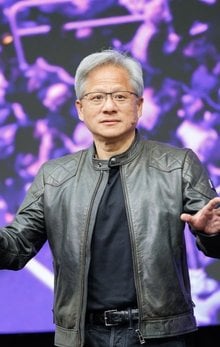
Jensen Huang, CEO of NVIDIA, perhaps one of the most prominent AI optimists, also sees AI as a tool to increase productivity, rather than reduce headcount. At the World Economic Forum in Davos, Jensen discussed this in relation to the use of AI in radiology.
“Not surprisingly, the number of radiologists has gone up,” he said. “The fact that they’re able to study scans now infinitely fast allows them to spend more time with patients.”
While David argues that AI will have a more significant impact on business productivity than headcount, he proposes that the process of implementing these technologies will not be as straightforward as many businesses predict.
He told the Goldman Sachs Exchanges podcast that the complexity of embedding AI within a business may lead to a “recalibration” of organisational expectations.
This suggests that the businesses most likely to succeed in an AI-informed business landscape will be those who deploy the technologies that are right for their organisation and prioritise upskilling to ensure employees can use AI effectively.
Company portals


Executives
David Solomon
Chairman & Chief Executive Officer
Jensen Huang
Founder and CEO
Mark Dixon
Founder & Chief Executive Officer