
How BMW Kept Staff Happy During Munich Factory Overhaul

When the last combustion engine rolled off the production line at BMW's Munich plant in late 2023, it marked more than the end of 75 years of engine manufacturing.
For Ilka Horstmeier, Member of the Board of Management of BMW AG, People and Real Estate, Labour Relations Director, it represented a profound moment of human transformation that would define the company's approach to the electric vehicle revolution.
"I knew many of the people who worked there personally – because I had the privilege of leading that plant and our worldwide engine production for seven years in total. I'll never forget that day," Ilka says.
"Standing in front of them, saying: 'This chapter ends here.' That was a tough moment for everyone. We all shed a few tears, I can tell you."
That emotional moment encapsulates the human resources challenge at the heart of BMW's ambitious transformation of its Munich plant – a facility preparing to become the company's first existing factory to convert fully to all-electric vehicle production by the end of 2027.
With serial production of a new electric sedan based on the Neue Klasse architecture scheduled to begin in 2026, the plant faces the dual challenge of undertaking a US$750m overhaul while managing the most significant workforce transition in its century-long history.
The human dimension of industrial transformation
For Ilka, the people element of the Munich transformation is an example to others.
"This campus is a symbol of how BMW approaches transformation: not as a technical challenge, but as a human one," she explains.
The scale of that human challenge is considerable. BMW is preparing 40,000 Munich employees for the future of mobility across multiple disciplines: electric drive trains, artificial intelligence, automation, robotics, and sustainable manufacturing.
This represents not merely retraining but a fundamental reimagining of skills and capabilities across the workforce.
The approach BMW has taken reflects what Ilka describes as a core conviction, saying: "A company can only prepare successfully for the future when everyone moves forward together.
“Because transformation isn't just a story we tell – it's a story of responsibility we live, every single day, as one strong Team BMW."
Individual care at industrial scale
The closure of engine production provided an early test of this philosophy.
When production ended, BMW faced the challenge of redeploying 1,200 employees whose roles had become redundant.
Rather than treating this as a mass redundancy exercise, the company adopted an individualised approach.
"We sat down with all 1,200 employees, looked at every single person's future and helped each one qualify for a new, future-proof role," Ilka explains.
"It was a huge effort – but it paid off. Because when people see that you care about them, you gain trust. And when they trust you, they don't just go through transformation – they drive it."
This approach reflects what Ilka characterises as a guiding principle for difficult business decisions.
"When you make a tough business decision, you can't think of every individual – but, afterwards, you have to take care of each and every one," she says.
"Despite the emotion, it was the right decision. Because only those who dare to make decisions early have the time needed to bring their people along," she adds.
Strategic workforce planning
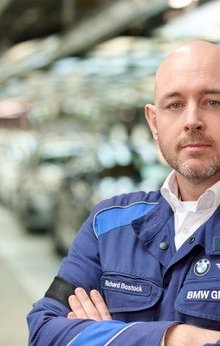
Richard Bostock, Head of HR Management BMW Group Plant Munich, says successful transformation requires precise alignment of people, roles and capabilities.
"Our major asset is our people. We work with universities, other companies and technology partners.
“In order to bring us into a new era, we need the right people in the right place with the right qualifications – making sure they know what's expected of them and how we can help them."
This strategic approach to workforce development has become essential as the plant continues to operate at full capacity during its transformation.
The facility produces an average of 1,000 cars per day across 10 shifts per week, with a production rate of 60 seconds per car.
In 2024, it manufactured over 83,500 BMW i4 electric vehicles, which now account for approximately 50% of total production.
The ability to maintain this production level while preparing for the Neue Klasse launch demonstrates the effectiveness of BMW's workforce planning.
Mohan Noronha, Programme Lead of the Structural Transformation of BMW Group Plant Munich, emphasises the challenge, saying: "We produce 1,000 cars per day with 70,000 square metres of construction – right in the middle of a city."
Infrastructure and skills development
The physical transformation of the plant has been substantial. Construction began more than two years ago and includes new body, assembly and logistics halls.
BMW demolished the plant’s combustion engine assembly facility and constructed a new body shop in one year and two months.
Engine production was relocated to facilities in Steyr, Austria, and Hams Hall, England, creating space for electric vehicle manufacturing.
Richard acknowledges the constraints, saying: "There are restrictions because we don't have a great deal of space here. It was important to move engine production to the network."
The limited space has forced BMW to think creatively about facilities and workforce development.
The company has established partnerships with universities, other companies and technology partners to ensure employees acquire the necessary skills for electric vehicle production.

Legacy and symbolism
BMW Plant Munich's status as the “parent” plant of the company gives the transformation a symbolic aspect.
Its history spans over a century, having started building aeroplane engines in 1922 before moving through military equipment, motorcycles and engines to passenger vehicles in 1952.
Ilka says: "This is a place that means a lot to BMW, to Munich and to me personally. Plant Munich inspires me for three good reasons: It spans over 100 years of industrial heritage, it is the very place where I began my career three decades ago and – perhaps most importantly – it is one of our most ambitious transformation projects."
The choice of the Neue Klasse name for BMW's new EV architecture deliberately echoes this history.
The original Neue Klasse launched at the Munich plant in 1962, becoming the forerunner to the BMW 02 and the 3 Series sedan – the best-selling BMW of all time.
Lessons for the C-suite
BMW's approach to the Munich transformation offers several lessons for executives managing workforce transitions in traditional industries facing technological disruption:
- The willingness to make difficult strategic decisions early provides the time necessary for proper workforce transition
- Combining strategic decisiveness with individual care builds the trust necessary for employees to become active participants in transformation rather than passive recipients
- Transformation requires viewing change must be viewed through a human, not purely technical, lens.
As Ilka says: "Transformation doesn't just happen in classrooms."
Company portals

BMW
Executives
Dr. Mohan Noronha
Project Lead Structural Transformation of BMW Factory Munich
Richard Bostock
Head of HR Management BMW Group Plant Munich

BMW
- BMW Names Brussels Airlines CEO as Labour Relations DirectorOrganisation & Culture
- Volkswagen Weighs 100,000 Job Cuts, Four Plant ClosuresOrganisation & Culture
- Sodexo Names Agnès Park CHRO as Delaporte RebuildsTalent Acquisition
- Bolt CEO: HR Was 'Creating Problems That Didn't Exist'HR Strategy