
HR’s New Tool: Using Tech to Fix the Skills Crisis
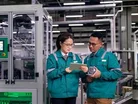
Automation, AI and product evolution are changing factory floors at a pace that human workforces have struggled to match. The result is a widening skills gap that threatens to undermine the very productivity gains that technology promises to deliver.
A Q4 2025 outlook survey by the National Association of Manufacturers found that more than half of manufacturers cited attracting and retaining a quality workforce as a top challenge.
State of skills in manufacturing
According to the World Manufacturing Foundation, 74% of companies report an acute shortage of skilled workers, and 94% expect to hire or repurpose workers through increased adoption of smart manufacturing technology. By 2030, more than half of the workforce in advanced manufacturing will need upskilling to meet changing demands, it says.
While many leaders understand talent retention is a significant problem, the impact of technology is less widely recognised as a contributing factor.
Gartner reported that nearly half of manufacturers regret their software purchases because of slow or difficult implementation. According to a Global Lighthouse Network report, for every US$2 spent on technology innovation, companies spend up to US$5 on scaling and adopting the technologies.
Is automation enough?
Criteria’s 2026 Candidate Experience Report found that 61% of manufacturing job candidates are considering leaving the industry. Additionally, 41% of job seekers in the manufacturing industry say competition is too high. It was also cited as one of the least desirable industries to switch into.
Just 17% of job seekers view employers’ use of AI positively, and the same amount worry that AI could replace their jobs. Of all job seekers, 67% believe AI will eliminate more jobs than it will create.
The World Economic Forum's Global Lighthouse Network, co-founded with McKinsey, has tracked frontrunners in Fourth Industrial Revolution (4IR) technology since 2018. Its network has grown to include more than 220 lighthouses across 35 industries.
In September 2025, the WEF introduced an entirely new designation: Talent Lighthouse. It recognises that technology alone cannot sustain 4IR gains without an equivalent transformation in how people are trained, deployed and retained.
Kiva Allgood, Managing Director at the WEF, explains: "Competitiveness today is no longer defined by efficiency alone, but by the ability to sense, adapt and respond at speed."
How HR leaders can upskill their workforce
Treating upskilling as a core operational strategy could help to navigate these challenges. By identifying the gap between capabilities employees have today and those the business will need as automation scales, training investment can be properly directed and justified.
Manufacturers that integrate workforce development into the technology roadmap from the start, rather than treating it as a downstream concern, may be better positioned to realise the productivity gains they purchased. A Global Lighthouse Network report found that wearables supporting training and upskilling improved overall equipment effectiveness by 53%, reduced non-value-added tasks by 56% and reduced scrap by 26% at one site.
Upskilling programmes must also confront perceptions of AI. Manufacturers that communicate clearly about how automation will change, rather than eliminate, roles could see better results in attracting and retaining talent. Training programmes could demonstrate this in practice, placing workers alongside new technologies from the outset.
Carolyn Lee, President and Executive Director of the Manufacturing Institute, said in an episode of McKinsey Talks Talent: "Jobs will change, but workers will remain. We need to help people understand which skills they need to attain to make sure those jobs endure."
See the full story in the April 2026 edition of Manufacturing Digital.
Human-machine collaboration
Across sectors, the most advanced manufacturers are not choosing between people and machines – they are redesigning work so that each amplifies the other.
Schneider Electric's Wuhan factory in China has been chosen as a Talent Lighthouse. After a 55% rise in automation and a 239% expansion of its product portfolio between 2024 and 2026, just 20% of its employees were initially skilled in automation. Onboarding took 75 days and technician turnover reached 48%.
By deploying agentic AI to track skill gaps, partnering with 11 vocational schools and introducing pay-for-skills career paths, the factory raised workforce readiness from 20% to 76% while cutting turnover to 6%.
Mourad Tamoud, Chief Supply Chain Officer at Schneider Electric, describes it as proof that "AI and human potential working together" can build "resilient, agile and future-ready workforces".
Global supply chains and local talent
In India, Apple is facing productivity gaps that make manufacturing costs 5% to 10% higher than in China, according to supply chain analysis. The culprit is a workforce skills deficit, not a lack of capacity.
From March 2026, Apple's Education Hub in Bengaluru is delivering digital literacy programmes across more than 25 supplier facilities, targeting 100,000 workers. The initiative, developed with the Manipal Academy of Higher Education, covers Swift coding, robotics and smart manufacturing.
The investment is part of Apple's global US$50m Supplier Employee Development Fund, reflecting how seriously multinationals are treating workforce capability as a supply chain risk.
Legacy industries and future skills
As manufacturers navigate the shift between EV and internal combustion engine production, more challenges can be created.
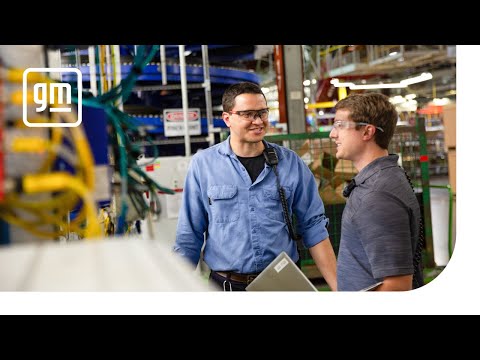
General Motors (GM) has invested US$30m in its Fairfax Assembly Plant in Kansas to prepare workers for dual-technology production, including both the gas-powered Equinox and next-generation EV models. The plant has operated in the community since 1946.
GM trains roughly 2,500 employees per year in advanced manufacturing and electrification at its Technical Learning University in Warren, Michigan. It has invested more than US$66m in higher education support for employees over the past five years.
Michael Youngs, GM’s Fairfax Plant Director, says: “The investment in people isn’t just about preparing for the production of new vehicles; it’s about giving our people the opportunity to build a future their families can be proud of.”
The top upskilling solutions
1. Siemens - SITRAIN provides comprehensive, continuous learning on topics from automation to industrial edge computing.
2. Rockwell Automation - Learning+ is a platform combined with virtual, instructor-led training that covers critical industrial skills like automation.
3. ABB - ABB University offers specialised training on robotics, motion, electrification and process automation.
4. Schneider Electric - Schneider Electric’s training solution focuses on energy management, sustainability and industrial automation.
5. PTC - Vuforia captures the knowledge of retiring experts using augmented reality and overlays step by step visual instructions.
6. FANUC - FANUC Academy offers specialised intensive training on CNC programming, robot operations and maintenance.
7. Bosch Rexroth - Bosch Rexroth Academy delivers hands-on and digital training in drive and control technologies, hydraulics and more.
8. Dassault Systèmes - 3DEXPERIENCE Edu trains on 3D design, simulation and PLM using digital twins of entire factories.
9. Honeywell - Honeywell Forge Workforce Competency is a solution that combines training with AI-driven analytics.
10. Emerson - Emerson Educational Services offers certified training for instrumentation, control valves and automation systems.
See the full story in the April 2026 edition of Manufacturing Digital.
Company portals




Executives
Kiva Allgood
Managing Director
Michael Youngs
Fairfax Plant Director

Mourad TAMOUD
Chief Supply Chain Officer