Why is IBM Tripling its Entry-Level Hiring?

IBM has announced it plans to triple its US-based entry level hiring “across the board” in 2026.
Speaking at Charter’s Leading with AI summit, Nickel LaMoreaux, Chief Human Resources Officer shared that the company is looking to increase its hiring efforts in a wide range of departments, confirming that “yes, it’s for all these jobs we’re being told AI can do”.
This initiative comes at a time where many companies are looking to reduce their headcounts due to AI – either through hiring freezes or job cuts.
How AI is changing hiring
In February 2026, Workday announced it was planning to cut around 400 employees from its workforce to better invest in its AI capabilities and remove ‘non-revenue generating’ customer support roles.
The company previously made 1,750 employees redundant in 2025 for the same reason, with Former CEO Carl Eschenbach saying: “We have so much opportunity ahead of us, especially with the potential of AI, and we have a strong foundation to build upon.”
Mustafa Suleyman, CEO of Microsoft AI, has also said that he believes AI is going to significantly change the way people work.
In an interview with the Financial Times, Mustafa predicted that white-collar roles will be automated by AI within a year and a half.
He said: “we're going to have a human-level performance on most, if not all, professional tasks.
“So white-collar work, where you're sitting down at a computer, either being a lawyer or an accountant or a project manager or a marketing person – most of those tasks will be fully automated by an AI within the next 12 to 18 months.”
AI in the workplace
With more organisations investing in AI, many business leaders are looking to effectively transition their workforce into AI-enabled roles – with a 2025 survey from Forbes revealing that 68% of Chief Human Resources Officers have a strategy in place to focus on human-AI collaboration rather than job replacement.
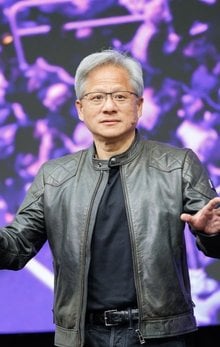
Effectively deploying this human-AI relationship could lead to significant job growth, says Jensen Huang, CEO of NVIDIA.
At the World Economic Forum in Davos, Jensen shared that he believes AI will create “six-figure salaries” for people in trade roles, saying: “This is the largest infrastructure build-out in human history that’s going to create a lot of jobs”.
According to Forbes’ survey, more than half of C-suite leaders agree – up from just 33% who felt AI would create jobs in 2024.
But these jobs are likely to look different to previous entry level jobs
Nickle says: “The entry-level jobs that you had two to three years ago, AI can do most of them.
“So, if you’re going to convince your business leaders that you need to make this investment, then you need to be able to show the real value these individuals can bring now. And that has to be through totally different jobs.”

IBM’s AI strategy
IBM first introduced AI to its Human Resources function in 2017 with HR chatbots.
These chatbots have since been combined into a singular ‘AskHR’ function, which automates over 90 human resources tasks – supporting 94% of HR interactions.
IBM is still looking to increase its workforce despite these significant AI developments, as Arvind Krishna, CEO at IBM, told the Wall Street Journal: “While we have done a huge amount of work inside IBM on leveraging AI and automation on certain enterprise workflows, our total employment has actually gone up, because what it does is it gives you more investment to put into other areas.”




Executives

Arvind Krishna
CEO

Carl Eschenbach
Chief Executive Officer
Jensen Huang
Founder and CEO

Mustafa Suleyman
CEO of Microsoft AI

Nickle LaMoreaux
Chief Human Resources Officer