
CSO Roles: A C-Suite Win For Women in Business?

While women’s representation in corporate leadership continues to be a challenge, a notable trend has emerged in one specific C-Suite role.
According to McKinsey’s 2024 Women in the Workplace report, women make up just 29% of C-Suite positions.
This contrasts with the role of Chief Sustainability Officer (CSO), where women appear to be leading the way. Data from the 2023 Davos summit, cited by Fortune’s Peter Vanham, indicated that of the 60 CSOs present, 60% were women.
This trend could suggest an evolution in how businesses perceive the skills required for sustainability leadership and its integration into corporate strategy.
Diverse leadership and performance
The connection between leadership diversity and business outcomes is an area of increasing focus. Research from McKinsey’s Diversity Matters Even More report found that leadership diversity is associated with better financial performance.
The report also links it to holistic growth ambitions, greater social impact and more satisfied workforces.
The prevalence of women in CSO roles may therefore have wider implications for organisational health and performance beyond sustainability metrics alone.
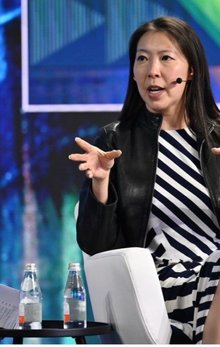
Christina Shim, CSO at IBM, commented on the collaborative nature of the field during the Women in Sustainability panel at Sustainability LIVE Climate Week NYC 2024.
“If you look across the board, there's many CSOs who are women, but it's not a woman or man thing — this is existential,” Christina says.
“This is everybody. It's all our communities. It's all our families. It's everybody, all our businesses. The only way that we're ever going to make the progress we need to is by creating business value. It's cost-cutting and revenue-generating as a growth enabler if you allow it to be part of your business,” she explains.
The CSO as a cross-functional influencer
The structure and influence of the sustainability function within a large organisation present unique challenges.
The CSO role is often not one of direct line management over large departments but one of influence across the entire business.
This requires a specific skill set centred on collaboration, communication and stakeholder engagement to embed sustainability principles into every function and business unit. It is a model of leadership that relies on persuasion rather than direct authority.
“Our roles are more of an influencer role, I don't have a thousand people on my team running sustainability around the company,” Christina explains.
She adds: “It is a small group and what we have to do is tentacle out and make sure that we are touching every function and business unit in the company. Especially with sustainability being increasingly important in how we think about our businesses, it is challenging when you're not necessarily in every room to make sure that you have influenced all the discussions.”

Systemic barriers and representation
Despite the progress in the sustainability field, systemic challenges for women in leadership persist.
Jennifer Motles, CSO at PMI, highlights the structural issues that can hinder female progression.
“There are many women in sustainability, but there are still so many barriers for women to actually be able to compete and thrive in equal ways because there's so much of the system that does not make it easy,” Jennifer says.
The visibility of female leaders in these roles is therefore important.
“It's important to have awareness of the privilege that we have in the positions that we hold, just by the fact that we are representing our companies in a leadership role. It means that you are bringing representation and paving a road that is wide enough that others can work with you,” she adds.






Executives
Christina Shim
Chief Sustainability Officer

Jennifer Motles
Chief Sustainability Officer
- Six Flags Rebuilds Its C-Suite and Undoes a Merger MistakeOperations
- It's Coming Home: England's Lesson in Building TeamsOrganisation & Culture
- Starbucks Invests in Employee Education ProgrammeEmployee Experience
- Air India's Chairman Takes Charge as CEO Search DragsOrganisation & Culture