McKinsey: AI is Not Showing Returns for 80% of Businesses

McKinsey & Company has released its 2026 The State of Organisations report, taking a closer look at the intersection of customer demands, workplace expectations and the evolving business landscape to understand how leaders can create value.
The report, which surveyed more than 10,000 senior executives, finds that tech-driven work models are shifting both how work gets done and the expectations of employees.
This means organisations are having to rethink traditional workplace structures and refine employee roles to improve performance and business competitiveness.
For many businesses, McKinsey suggests that this requires further collaboration between humans and AI agents to find further value in the organisation.

How AI is changing organisations
According to McKinsey, while companies are adopting AI at scale, few are seeing high returns.
The report finds that less than 20% of companies that have attempted to adopt the technology have seen a significant impact on their income, while 86% of leaders say their organisations are not prepared to adopt AI in day-to-day operations.
Senior leaders’ top three barriers to adopting AI are concerns around the technology at 46%, ethical or legal concerns at 44% and organisational challenges at 39%.
To improve AI adoption, the report recommends business push for ‘organisational transformation’ to make wide scale shifts that can reshape how companies operate.
Discussing the report’s findings, Bettina Dietsche, Chief People and Culture Officer at Allianz, says of embedding AI in an organisation: “I think adaptability is the thing that matters most.
“The speed of change today means that if you fall behind, you don’t necessarily have an opportunity to catch up. We need to be ahead of the wave, which means training and educating our people to feel comfortable using technology instead of being afraid.”
Allianz itself has developed an AI upskilling initiative called the “Global AI Run”, which was awarded an International Brilliance Award for digital capability development.
This is helping the insurer to better transition AI into its operations, driving productivity and improving day-to-day use of the technology.
It uses webinars with AI experts and role-based learning pathways to facilitate practical AI application, and has reached more than 144,000 employees spanning over 70 countries.
Bettina says: “The biggest game changer is to connect technology with our people, mindsets and culture.”
Human-AI collaboration
McKinsey suggests that organisations will need more than structural change to successfully integrate AI, however. To achieve an AI enabled model, the report says businesses must encourage human employees to collaborate more with AI agents.
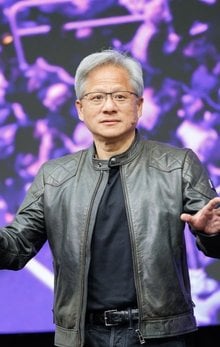
Jensen Huang, CEO of NVIDIA, agrees. He has previously said that he believes AI Agents will one day need to be absorbed into a company's culture just like human employees.
In an interview with Citadel Securities, he described AI employees as probably being a “couple-of-trillion dollar market opportunity” for businesses, suggesting that there will be a future with “AI digital nurses, AI accountants, AI lawyers”.
He added: “I wouldn’t be surprised if you licence some and you hire some, depending on the quality and depending on the deep expertise.
“So future workforces in enterprise will be a combination of humans and digital humans.”



Executives
Bettina Dietsche
Chief People and Culture Officer Allianz Group
Jensen Huang
Founder and CEO