
Amazon Facility Tests Staff Wellness Technologies
Buildings and construction account for 40% of global greenhouse gas emissions, according to the Carbon Leadership Forum. This significant environmental impact is pushing companies to rethink how they design and build their facilities, with implications that extend beyond environmental performance to affect the people working inside them.
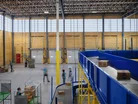
Amazon's new delivery station in Elkhart, Indiana, demonstrates how sustainable construction practices intersect with employee wellbeing initiatives. The facility, known as DII5, incorporates more than 40 market-ready technologies that address both environmental performance and working conditions.
The ecommerce giant is advancing its goal to decarbonise global operations through improvements across its network of fulfilment centres and delivery stations, whilst simultaneously creating spaces that support workforce health and productivity.
The delivery station functions as a real-world laboratory where Amazon can gather data on sustainability initiatives and evaluate their effectiveness.
Daniel Mallory, Vice President of Global Realty at Amazon, says: "We have experimented with and implemented a lot of sustainability initiatives over the years. DII5 continues that effort by taking a culmination of a lot of big ideas not just in how we operate our facilities, but in how we build them. And it's going to help us as we steadily climb toward our sustainability goals."
Circadian lighting supports employee health
Training and break rooms feature circadian lighting that shifts between day and night cycles, saving energy whilst supporting employee wellbeing. These intelligent systems adapt to the natural rhythms of the workspace, creating a more sustainable and comfortable environment for employees. The lighting technology mirrors natural daylight patterns, which research suggests influences alertness, mood and sleep quality amongst shift workers.
The facility's construction choices also affect indoor air quality and comfort levels for staff. The walls feature mass timber, also known as engineered wood, whilst the foundation uses lower-carbon concrete. Mass timber is created from softwood pieces such as spruce, fir and pine that are laminated together, producing a material with structural strength comparable to concrete and steel.

Kristen Dotson, Principal for Sustainable Buildings at Amazon, says: "Trees absorb carbon from the atmosphere, store it in the cells of their fibre. If we can lock up that material in the building for 50 to 100 years, we're creating a carbon 'bank' that keeps that sequestered carbon from being re-released into the atmosphere.
The game-changing part around mass timber is that it's taking a ready commodity and turning it into this structural element that can replace much of the concrete and steel that goes into a building. Before mass timber, we didn't have a market-ready bio-based structural solution that was competitive with concrete and steel."
Resource conservation affects daily operations
The facility combines mass timber with lower-carbon steel to support both the roof and the canopy covering Amazon's delivery vans. The roof itself is constructed from composite wood and incorporates heat pumps for efficient heating and cooling, which reduces the site's energy consumption.
Bio-based materials have been prioritised throughout the construction, including wood studs replacing metal ones at interior partitions and wood fibre insulation substituting for fibreglass.
Low-flow water fixtures throughout the facility aim to maximise water conservation and reduce dependence on municipal water supplies. A water reclamation system collects rainwater from the roof, filters it and stores it underground in a 56,781-litre tank. This captured water is then routed to the facility's restrooms for use in toilets, reducing the building's overall water consumption from municipal sources.
Outside the facility, more than 170 EV charging stations support the transition to electric delivery vehicles. The company plans to use information gathered from DII5 to identify which technologies offer the optimal balance of cost and performance, providing insights that inform global expansion and influence how warehouse employees experience their working environments in future facilities.
Company portals

Executives

Daniel Mallory
VP Worldwide Real Estate